|
EMR-2025 took place 14–16 May 2025 at Tallinn University of Technology, Estonia. This three-day workshop focused on the Energetic Macroscopic Representation (EMR) methodology for modeling and controlling complex electromechanical systems. The workshop was aimed at doctoral students in engineering and technology.
EMR-2025 was conducted by IEEE VTS Distinguished Lecturer Alain Bouscayrol and Prof. Betty Lemaire-Semail from L2EP/ University of Lille (France). The event was sponsored by VTS and organized by the VTS Estonia Section Chapter, led by Chapter Chair Anton Rassõlkin.
EMR is a graphical formalism introduced in 2000 to describe complex electromechanical systems. It has since been extended to complex multi-physical systems (thermal science, electrochemistry, fluid mechanics, etc.). EMR is based on the action-reaction principle to organize the interconnection of models of subsystems according to the physical causality (i.e., integral causality). This description highlights the energetic properties of the system (energy accumulation, conversion, and distribution). Moreover, an inversion-based control can be systematically deduced from EMR using specific inversion rules.
Compared with other graphical descriptions, such as Bond Graphs or Causal Ordering Graphs (COG), EMR has a more global energetic view and contributes to the system’s control design. It differs from structural description tools such as Physic Modelling Language (PML), which uses an object-oriented modelling language, making its libraries coupled like physical units. EMR focuses on the system's function, not just its structure. EMR provides insights into the actual energy operation of systems, enabling a deep understanding of their potential from a dynamic perspective.
Learn more about EMR here: https://emr-website.univ-lille.fr/
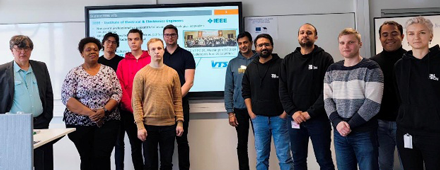
IEEE VTS Distinguished Lecturer Alain Bouscayrol (left) with EMR-2025 participants, including IEEE VTS Estonia Section Chapter Vice-chair Mahmoud Ibrahim (4th from the right).
|